
Public electric transport is an important component of urban mobility systems, especially for some segments of the population. However, today Ukrainian cities are forced to maintain its operation in conditions of unprecedented challenges: regular shelling, electricity shortages and acute shortage of personnel. At what percentage of its capabilities does electric transport operate in conditions of war, energy restrictions and a personnel crisis? To answer this question, in February 2026, the Vision Zero NGO team conducted monitoring of the actual use of tram and trolleybus rolling stock (RS) in Ukrainian cities. The monitoring results allowed us to make a cross-section of the situation, compare cities with each other and have a basis for similar monitoring and comparisons in the future.
Methodology
To assess the use of public electric transport in the cities of Ukraine, we applied an approach based on comparing the actual production of rolling stock with the existing inventory. Actual data was collected using real-time monitoring during the morning peak hours, when the load on the transport infrastructure is traditionally the highest. The number of transport units on the routes was recorded on February 24-26, 2026 from 08:00 to 9:00 and from 9:00 to 10:00 according to the data of the GPS monitoring systems "Dozor" and "EasyWay" (in some cities the peak of operation begins at 9:00 in the morning). The recorded number of rolling stock on each route was added into the database manually. The source of information on the inventory is the Corporation "Ukrelectrotrans" , as of 2025.
The rolling stock operation rate was calculated as the ratio of the actually detected amount of transport on the lines to the total amount of available inventory of a particular city. The highest recorded total operation figures for each city were taken for the rating. The rating did not include cities where data from GPS trackers was missing during the monitoring period: Odesa, Kryvyi Rih, Konotop, Druzhkivka, Kherson, Ternopil, Sloviansk.
The tram counting methodology does not take into account multi-unit systems (trains of several coupled trams), since according to GPS monitoring data, it is impossible to determine the output of cars in the couplings.
The big picture
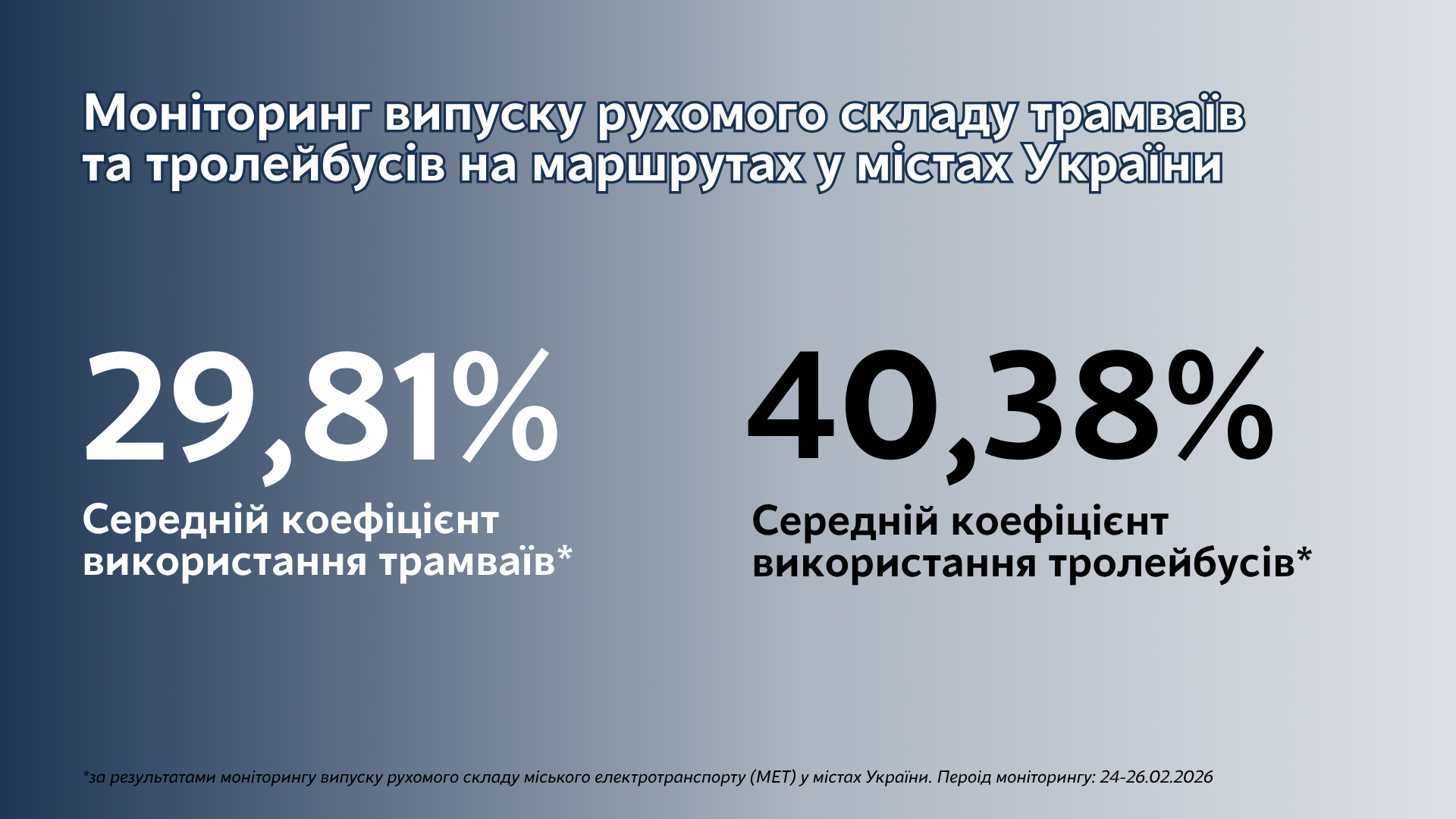
In EU cities, the normal level of operation rate on rolling stock routes is considered to be 60-80% for large tram systems, 50-70% for small and medium systems, and 65-85% for trolleybus systems. Our measurements, conducted during the morning peak hours (from 08:00 to 10:00), showed that the average Ukrainian figure does not even come close to reaching these levels of over 60%:
- The average tram operation rate was 29.81%.
- The average operation rate of trolleybuses is 40.38%.
Of course, energy constraints have a significant impact on these indicators. Restrictions on electricity supply and its high cost often force municipalities to consciously reduce the operation of energy-intensive transport. In some cities, energy supplies to electric transport enterprises on the day of monitoring were in full, and in some - probably not. These differences in energy availability were not taken into account when calculating the monitoring results.
The phenomenon of frontline cities: resilience despite circumstances
The most inspiring result of the monitoring was the indicators of cities that are near the front line or constantly suffer from Russian terror.
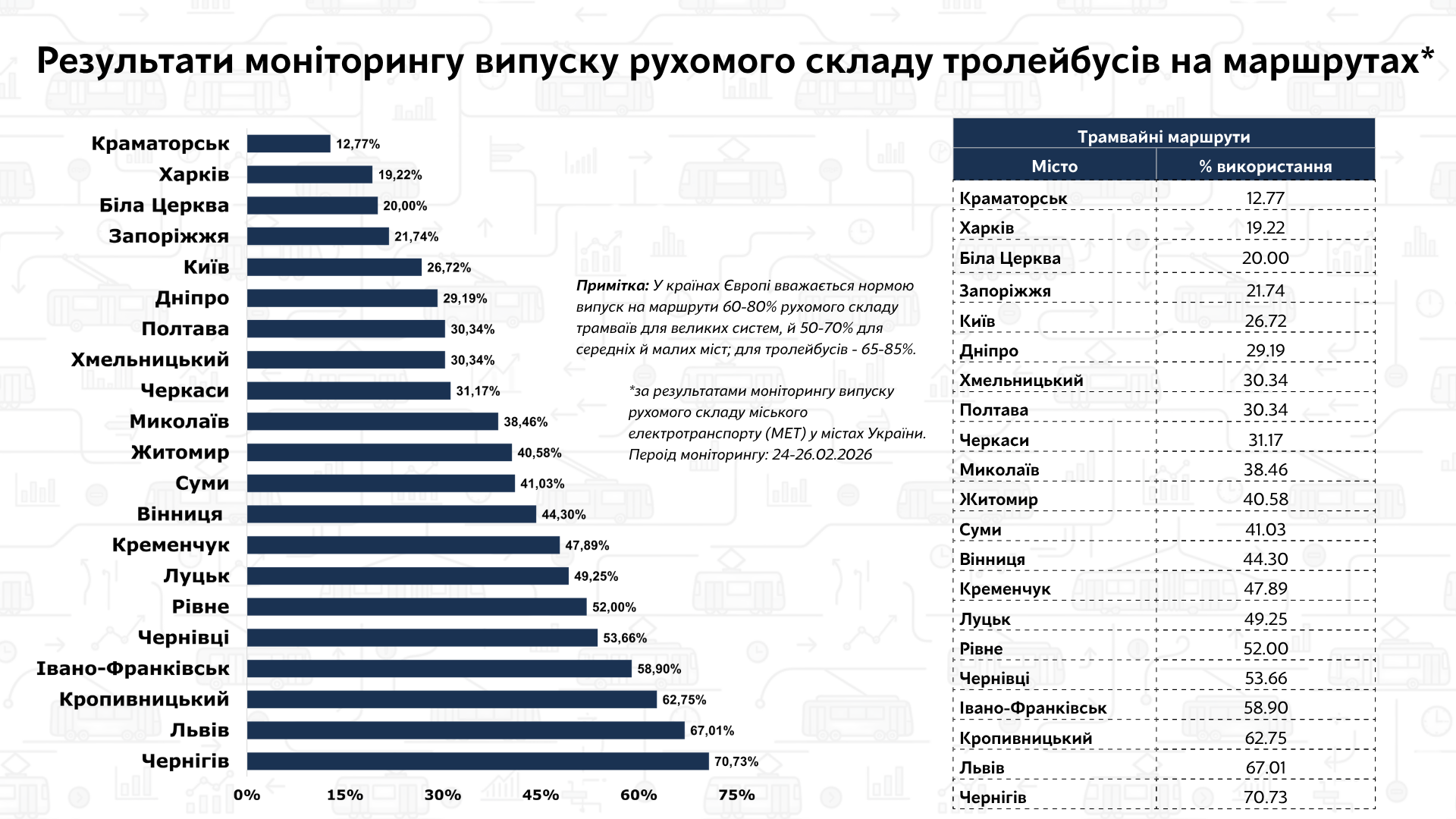
- Kramatorsk deserves special attention. Despite the constant threat, maximum proximity to the front line and regular brutal shelling, the city continues to run public electric transport on routes. Even the very fact of daily operation of trolleybuses in such extreme conditions is evidence of the incredible resilience of local transport workers and the vital need to maintain mobility for citizens.
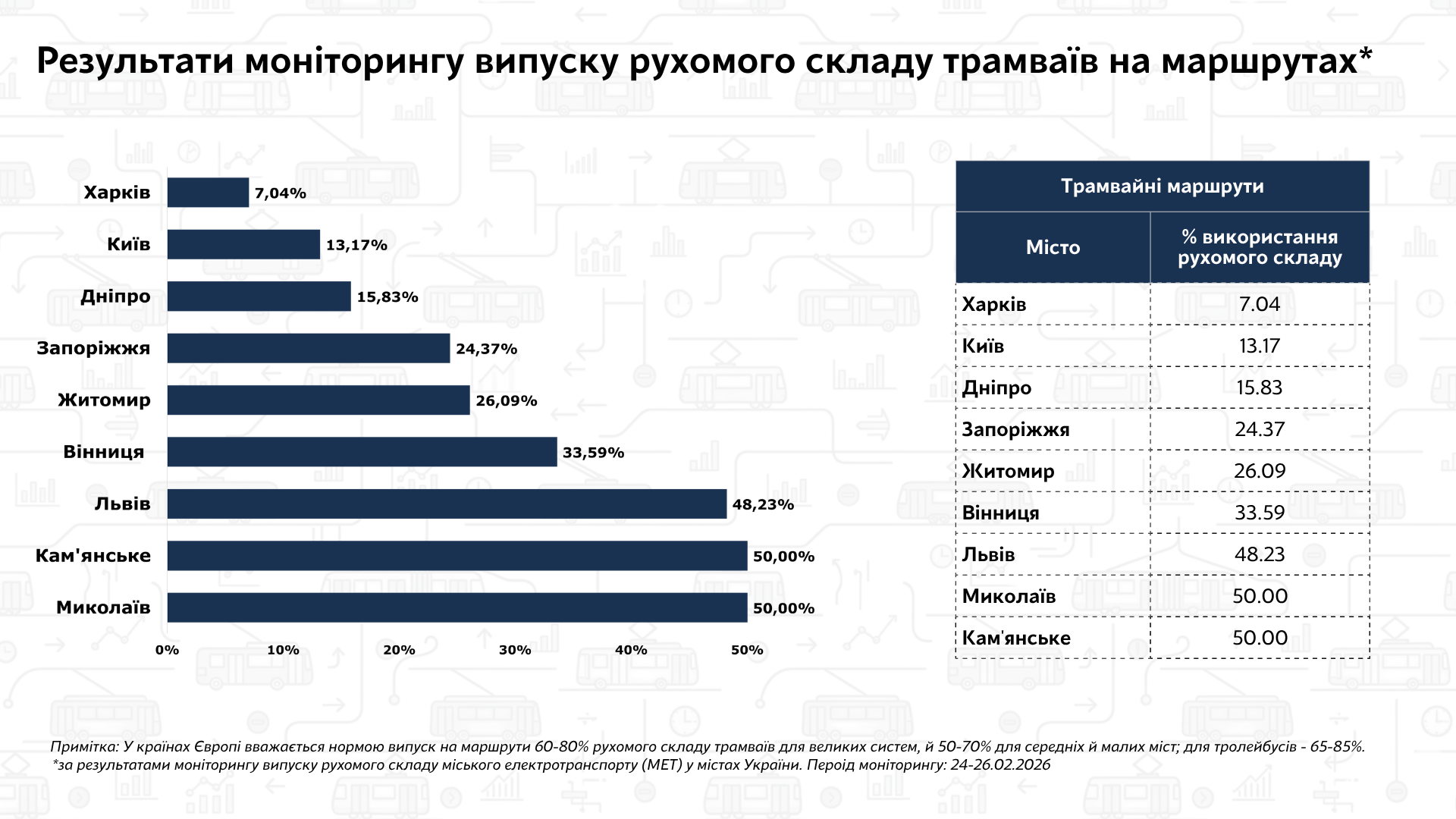
- Mykolaiv shared first place in Ukraine in terms of the percentage of tram operation ( 50% ) with Kamianske, and also showed a good result in trolleybuses ( 38.46% ). The city, which has been under daily attacks for a long time, is finding resources to maintain electric transport in working condition.
- Chernihiv , which survived a severe siege in 2022, became the absolute leader in Ukraine in terms of trolleybus on-route operation — 70.73% .
- The border regional center of Sumy showed a relatively high coefficient of 41.03%.
Reservation
The study only takes into account the nominal number of rolling stock on the balance sheet of municipal enterprises as of January 2025. The monitoring does not take into account differences in local policies: some enterprises more regularly decomission idle rolling stock, while others, on the contrary, keep such units on their balance sheet. The monitoring also does not take into account differences in the energy supply of cities and enterprises and possible power outages that may have occurred on the monitoring days.
Additional information
We plan to conduct similar monitoring in the future, and will use the first monitoring as a basis for comparison. Tables with monitoring results for 24-26.02.2026 can be downloaded as Google Sheets at this link .
Monitoring was conducted by: Yuriy Lozovenko; publication was prepared by: Yuriy Lozovenko, Kateryna Lozovenko, Viktor Zagreba.